

by Anonymous
Editors’ Note:
The Editors of Personspectives has removed the author’s name to maintain anonymity and protect their privacy. Content may include sensitive themes; reader discretion advised.
Nobody teaches you the sound of divorce.
For Ava it wasn’t the crashing plates or yelling arguments that everyone else imagined, it was the sound of silence, placed carefully between sentences like obstacles of intention. It was the sound of two people learning to speak to one another without touching the same air.
She thought the day it started would be loud and obvious-a slammed door or a broken china plate. She didn’t expect it to be quieter, to be the space between them growing until it had swallowed whole dinners and early conversations that ended before they had even properly started.
And then her parents used the word.
“Divorce.”
They used it as though it had been something existing quietly in their house all along, like they were just finally acknowledging the name of the unwanted tenant who had long since made themselves comfortable on the sofa.
After that everything became logistics.
Two houses, two separate schedules, two versions of “home.”
Ava learned to pack bags that were never quite correct-forgetting chargers or leaving books she no longer knew which version of herself they belonged to.
Mornings at her mom’s were a soft kind of quiet, like someone carefully trying not to disturb the slumbering past. Mornings at her dad’s were the droning sound of a TV on even when nobody was watching, filling the space with noise it didn’t truly know how to occupy.
She stopped using “home” and started saying “mom’s house” and “dad’s house,” as if language was trying to catch up with the swift realities of their separation. Choosing where to go wasn’t the hard part; it was realizing that no single place felt like her whole home anymore.
One night she sat on her bed, phone on the pillow facedown, and stared at the wall of a room she barely recognized anymore. The streetlamp outside buzzed and flickered, like it too couldn’t decide if it was still on or not. She wanted to ask the question that she had never dared to ask out loud: “Where am I from now?”
But the question felt too enormous for the small room, so instead she opened her notebook. She started to write down the things she couldn’t say to either of the houses she was now shuttling between. Words about missing a family she could still see in old photos, words about how love doesn’t always disappear it just re-shapes itself into a harder form, words about how tired she was of feeling just “fine” in two directions.
Writing it didn’t fix anything, but it did something quieter. It made the split feel less like something happening to her and more like something she could describe. Weeks, then months, passed.
She became better at moving between homes and better at remembering where her things went. She got better at smiling in two different kitchens. She also, slowly, got better at something else: knowing when she was not okay.
One afternoon she wrote a sentence she didn’t expect to:
“Maybe I don’t have one home right now, I have pieces of it, and but it is okay. At least I have a home.”
She paused. It felt like truth. And the truth, for the first time since the house had learned to split, didn’t feel like it was breaking her. It felt like something becoming slowly real enough to stand on.
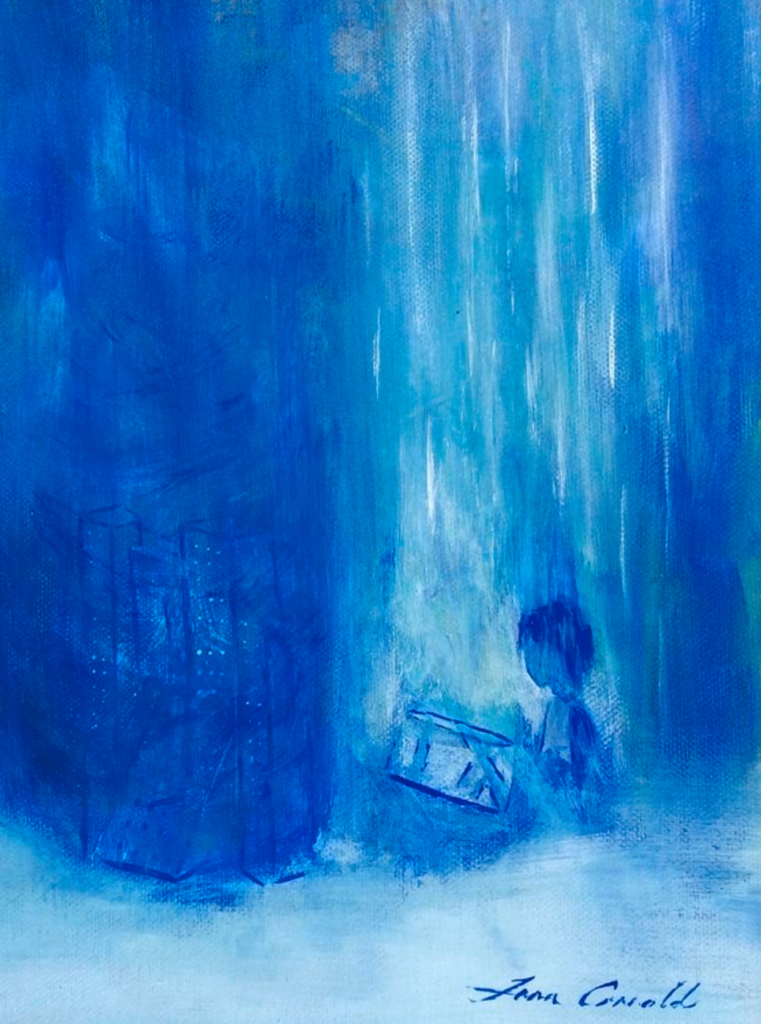
Painting by Tara Arnold, “The Little Drummer Boy (2020)“
About the Author
The author writes bold, emotionally driven stories that explore vulnerability, healing, and identity, with the intention of raising awareness that it is okay not to be okay.