

by Aanya S
The air in the living room hung heavy with the scent of incense and overcooked cardamom. It wasn’t an unpleasant smell, but it was… Substantial. Riya sat on the edge of the plush velvet sofa – the kind that looked expensive but was actually a little sticky on warm days – its cushions collapsing under her to impose a rather rigid, obedient posture. Aunties were sprawled out on every available surface, their chatter a chaotic cacophony, each voice competing for dominance like a pack of radio stations.
Someone had brought laddoos. Others had brought opinions.
Riya clasped her hands together in her lap, her phone face down on the coffee table next to her, as though even the contemplation of escape would be considered a lapse in manners. Her mother, across the room, positively beamed. Not a soft, motherly kind of beam, but rather, the “it’s going exactly according to my master plan” kind.
“Of course, she’ll move back home,” her mother chirped, her smile stretching a little too wide. “She knows how important family is. She’s not like these American children.”
A low murmur of agreement swept through the assembled crowd.
Riya blinked. Move back home? She glanced at Arjun, her fiancé, who was sitting beside his parents and nodding as if agreeing to a perfectly sensible and foregone conclusion. Her chest tightened. The plan, apparently, was that following the wedding, Riya would pack her bags, abandon her apartment, her career, and her city, and relocate to Arjun’s family home in New Jersey. Three generations, all under one roof.
“Just for a little while,” someone added helpfully, which, knowing how these conversations went, only made it worse. A little while in this context meant indefinitely.
Nobody had asked Riya. Not directly. Not really. So objecting felt rude, inconvenient, even selfish. She’d learned early how to recognize the shape of decisions made in her absence: they never began as questions; they only ever manifested as expectations.
The aunties were leaning forward now, invigorated. “In our days, we all did this,” one declared. “It was normal,” another agreed. “We never thought twice,” a third chimed in. “Family comes first,” her mother concluded, sealing the deal. Riya offered a small nod, a reflex. Arjun’s mother offered her a warm, inviting smile, clearly picturing Riya in her new home, in her kitchen, integrated into the family’s routine.
Riya pictured it too – the early mornings, the shared living spaces, the quiet erasure of being able to close her own door and just be. Her apartment, no matter how small, overpriced, and imperfect, suddenly felt like a holy sanctuary that was slipping through her fingers.
“I’ll go make some tea,” Riya said suddenly, standing up before anyone could stop her. Her mother smiled, approving. Of course, she would. Good girls knew their place.
The kitchen was a little quieter, albeit still noisy in a contained kind of way. Riya gripped the edge of the counter, staring at her reflection in the microwave. She looked perfectly acceptable – composed, agreeable, like someone whose life wasn’t being re-engineered without her in a room full of people who would not have to live that life.
“You okay?”
Riya turned. It was Meera, Arjun’s younger sister, leaning against the doorframe, arms crossed. Riya let out a breath she hadn’t realized she was holding. “Did you know about this?” she asked.
Meera shrugged. “Yeah. They’ve been discussing it all week.”
Riya gave a short, sharp laugh. “Of course, they have.”
“You don’t have to do it,” Meera said matter-of-factly.
Riya blinked. “It’s not that simple.”
“Why not?”
Riya hesitated. Because it would upset Mom. Because it would be awkward. Because I’d look ungrateful. Because saying no is so much louder than saying yes. “I just… Don’t want to cause a scene,” she finally said.
Meera tilted her head. “They’re already causing one. You’re just not playing.”
Riya looked down at the kettle, which she hadn’t even bothered turning on. “You know what happens if you say yes?” Meera continued. “Everyone in that living room will be incredibly pleased. They’ll be very proud.”
“And then what?” Riya asked.
“And then they’ll go home,” Meera said. “And you’ll still be there.”
That hit home. Hard. Riya turned the kettle on. The click seemed deafening in the relative silence. “What if they think I’m selfish?” she asked in a small voice.
“They will,” Meera said immediately.
Riya let out a small, weary laugh. “Great.”
“But you’ll still have your life,” Meera added.
A beat of silence. The water began to hum, rising in pitch, filling the space. For a fleeting moment, Riya saw it clearly – two different versions of herself: the one who nodded and smiled and acquiesced, and the one who spoke, even if her voice trembled. It was not a monumental difference, but rather, a single sentence.
“You’re allowed to want things,” Meera said softly.
Riya swallowed. “I know,” she said, but knowing and doing had never been the same thing.
The kettle clicked off. Riya didn’t move. Then, slowly, she reached over and turned it off again, just to hear the sound. A small reset. “I’m not making the tea,” she said.
Meera smiled. “That’ll definitely get their attention.”
Riya let out a full breath for the first time that night. “Okay,” she said. “Okay.”
When she re-entered the living room, the conversations ebbed to a lower volume. Not silence, but enough. Her mother’s eyes drifted down to Riya’s hands. Empty. A brief flicker of confusion crossed her face. “Tea?” she prompted.
Riya shook her head. “No,” she said. There was a pause. “I actually wanted to say something.” The room fell into a truly quiet state. Riya felt her heart pounding, but her voice, surprisingly, was steady. “I’m not moving,” she said. The words hung in the air, simple, blunt, final. “I’m happy to help out in other ways,” she added, glancing momentarily at Arjun, then back at the faces around her, “but I’m not giving up my apartment.”
Silence. Then, her mother’s face morphed from shock to calculation. The aunties exchanged glances. Arjun opened his mouth to speak, then closed it again. Meera leaned back against the wall, observing. It wasn’t a dramatic scene – no shouting, no immediate resolution. It was simply a disruption. A break in expectation. Riya stood there, upright and awkward, exposed but not shrinking. And for the first time that evening, the room felt as if it had air in it.
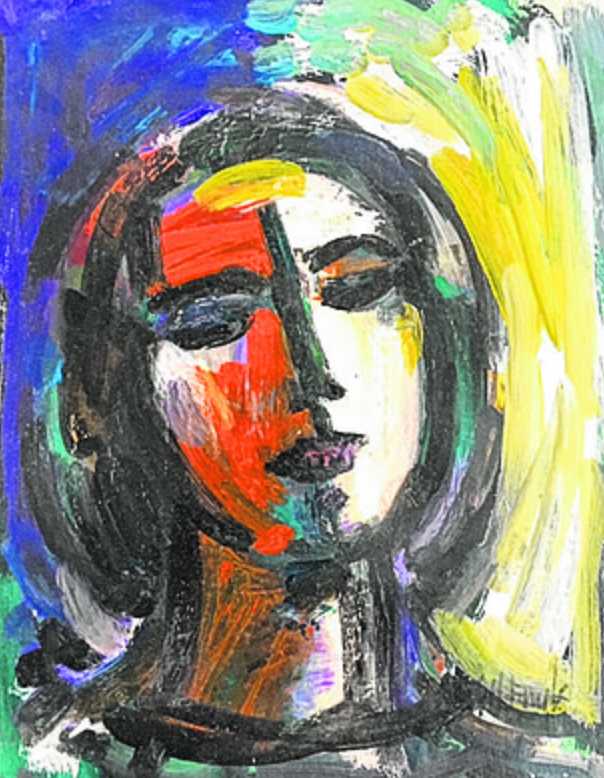
Art by Carley Olejnicza, “Oneness“
About the Author
Aanya writes mostly at night and insists she works best under mild panic.