

by Ashley Li
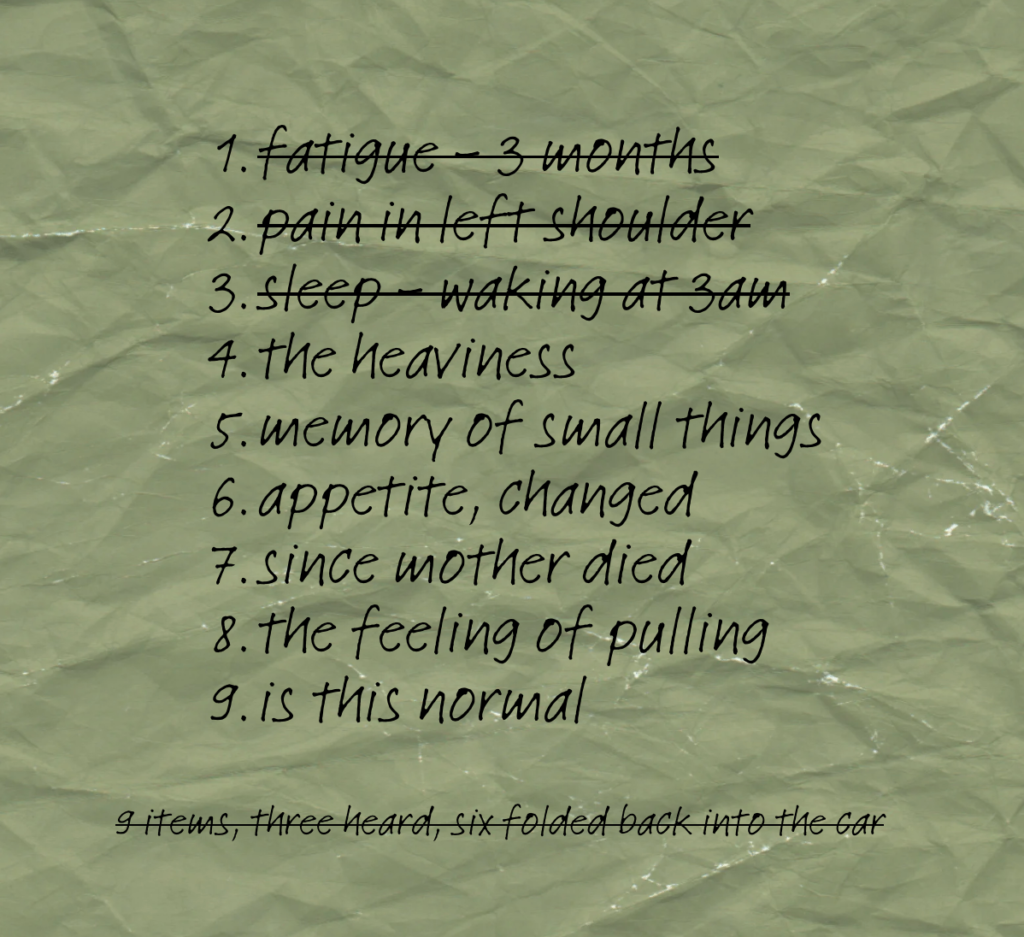
The waiting room air smells like a Tuesday afternoon you just want to end. This woman is 63 years old and she’s brought a list. It’s been creased from hours in the car, in the elevator, in the waiting room chair. You know the one, the one that faces the fish tank and there’s one fish tilting to the left a little. She’s not going to pull out that list until she feels like he’ll believe her.
Then, in comes the doctor. You know the way doctors come in: a blur, already halfway to somewhere else, white coat like forward motion. He sits, flips open the chart. The chart says: normal. Blood results, normal. Imaging, nothing unusual. Vitals, within normal range.
She unfolds the list.
He looks at the list, and doctors sometimes do this thing where they look at lists and they see evidence for something other than a physical ailment.
The problem is the chart can’t hold these things:
The 3am vibe of the pain. The fact that it doesn’t come as an event, but like a weather front, a low-pressure system that starts building for days, and then it hits. The precise cadence of her fatigue. It’s not really tiring. It’s a weight in her bones, as though gravity just tweaked its rules without asking her. The left-tilting fish. The creased-up list.
She has nine points on her list. She’ll probably get through three of them.
It’s not really the doctor’s fault, of course. He has 14 minutes. The system handed him 14 minutes, and within those 14 minutes, there are charts, billing codes, the baggage of all his previous patients, the weight of everyone coming after her, and the all-important chart that says normal, normal, nothing unusual, within normal range.
But that “within normal range” thing is an issue because that range is based on someone else’s body.
Medicine learned to speak in data because data does not flinch. Data does not cry in the parking lot or call back three times or bring a list. Data is a clean, portable object you can hand to an insurance company.
But the body is not data. The body is a story that keeps revising itself. It contradicts. It uses metaphor. It says: it feels like something is pulling and means something precise and untranslatable by any ICD-10 code in existence.
What would it mean to practice medicine as if the list mattered?
Not to abandon the chart, the chart saves lives, the chart is a miracle of accumulated knowing but to hold both: the number and the narrative, the scan and the sentence that begins: the summer my mother died.
The best clinicians do this already. They are doing it right now in fourteen-minute increments in rooms that smell like everyone’s worst Tuesday. They are translating between the language of the body and the language of the system, simultaneously, fluently, at great personal cost.
She refolds the list on her way out.
Six items unread. A fish listing left. The elevator, the car, the particular quality of afternoon light that asks nothing of anyone.
She will try again in three months.
About the Author
Ashley Li is a medical student who believes the best clinical training happens as much on the page as in the ward. She writes essays and keeps a journal ? both, she suspects, for the same reason: to pay closer attention.