

by Reneisme Elridge
I used to believe that identity was something everyone else could see immediately, as if it were a tag that was assigned to me without my consent. In classrooms, and even the lingering glance from a stranger, it always felt like I was being assessed before I had a chance to speak.
At some point, however, I became more attentive to the extent to which I varied depending on who was observing me. Subtle shifts, not drastic ones, are what I noticed-how I carried myself, the intonation of my laughter, and the ways I tried to mold myself into a more easily recognizable figure in other people’s minds. This was not an intentional conscious decision at first. It was more of a primal response, akin to the way my body learns the norms of different spaces without actively agreeing to them.
I became acutely aware that other people seldom inquired about my identity; they simply assumed it. Subsequently, they proceeded as if their assumption were the baseline reality.
The question was not whether I knew who I was but rather the whereabouts of the boundaries between my sense of self and other people’s assumptions about me. The shifting border of who I was, where “I” ended and “they” began, was fluid, and constantly dictated by what other people seemed to want to believe about me based on previous understandings and anticipations.
Language added another layer to this uncertainty.
Words such as “he,” “she,” and “they” ceased to resemble descriptors; they were merely audible guesses from other people. On certain occasions, the guesses aligned with what I was feeling at the moment; other times they did not, or worse, they morphed into completely different interpretations so rapidly within the course of a single day as to seem as if my self was being rewritten in real time without my involvement.
I would witness myself move through environments where identity was being multilayered; one person interpreted me one way, the next a different one, with neither version canceling out the other. I came to realize that it was not one reflection of “me” that bounced back, but many fragmented ones, all perceived to be concrete by their viewers.
The most peculiar element of all of this was that all individuals were sure about what and who “I” was, even if their ideas completely contradicted one another.
In instances like these, there was a yearning for something solid-a singular concept I could cling to without much thought. A version of “me” that did not morph based on the context, distance, light or my viewer’s predictions. Eventually, however, I began to question if the mere wish for stability was part of the problem; perhaps I wasn’t supposed to be something static. Perhaps I was something more akin to being relational, only fully realized when shared, exchanged, and perceived.
This idea felt unstable at first, like I was losing ground. Over time, though, it became less daunting.I then turned my attention to subtler shifts: the alteration of my voice based on my conversation partner, the imperceptible change in my posture, and how certain physical settings increased or decreased my sense of being “seen” without me having physically changed in any way.
It seemed as though I wasn’t a monolithic object moving through space; I was a flexible pattern of reactions in response to my surroundings.
Interestingly, this realization did not erase me. It lessened the burden of trying to present only one “correct” version of myself at any given moment.
Over time, the struggle to firmly categorize myself gave way to a notion of the self as a work in progress. My identity was no longer something to be solved or cemented, but something unfolding slowly and publically without any finished state anticipated. This wasn’t because I was incomplete; it was because I was continuous.
Despite this newfound awareness, moments of instability persisted; times when I wanted to feel seen in a specific way by another person and when their inaccurate perception felt acutely real and weighty, not theoretical. Yet, even in these moments, they ceased to feel like failures; they became more like components of a larger, more convoluted process of seeing and being seen.
Additionally, I realized that the more I retreated from solidifying my identity, the more space there was for me to simply exist, unburdened by constant self-correction.
This did not lead to greater certainty, but rather a significant decrease in tension.
At this juncture, I began to apprehend a concept I had overlooked before: identity is less something one arrives at and more something one constantly practices with others, an ongoing process that never culminates.
This meant I didn’t need to feel complete, either.
All I had to be was present.
Just here, in whichever form that might have been in that moment, without needing it to be the last.
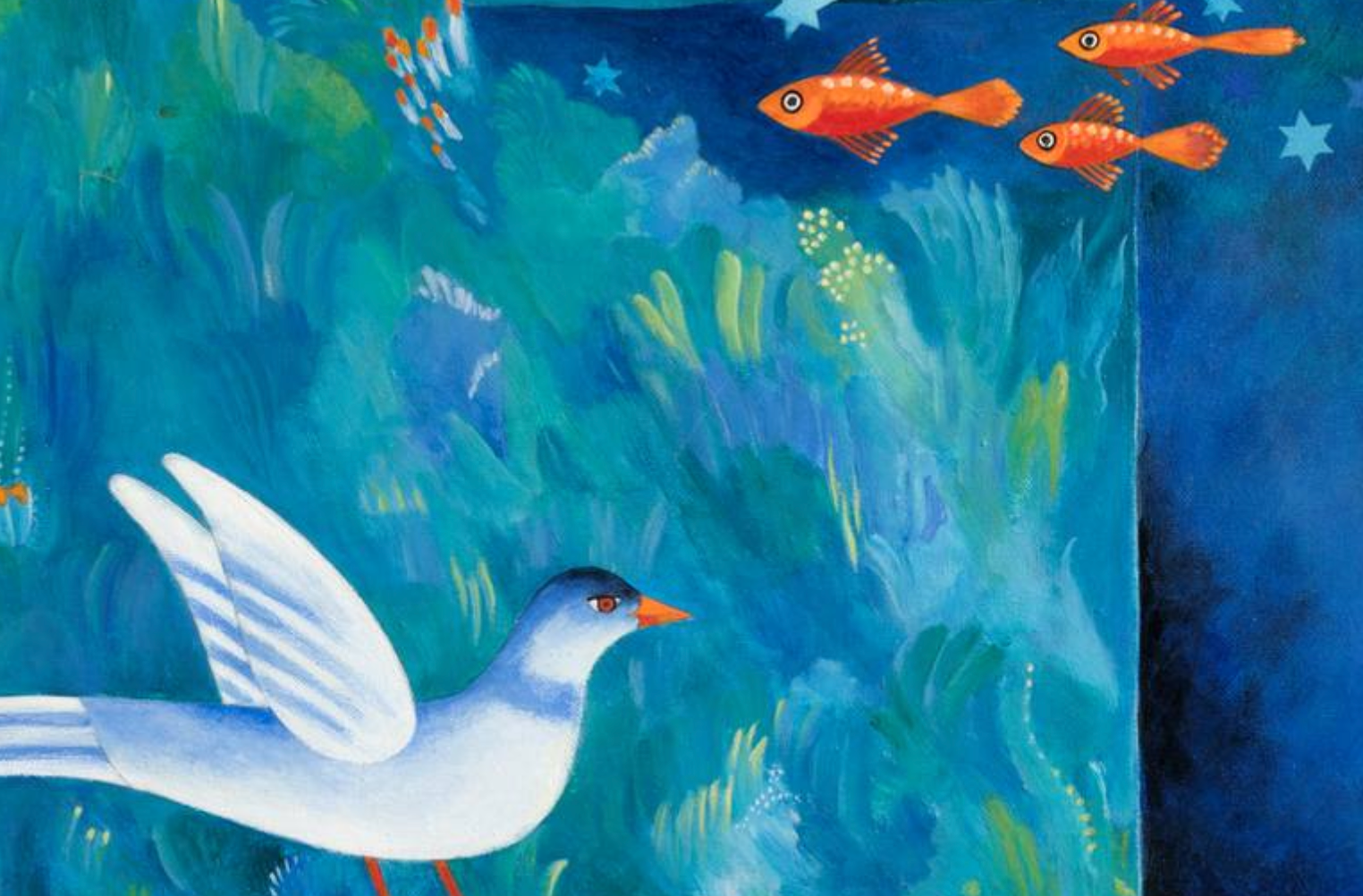
Painting by Jacqueline Schreier, Fantasy in Blue
About the Author
Reneisme loves weird essays and long walks with his dog.