

by Makayla Barraud
We learn about politics before we are ever asked about it. Not in a school sense necessarily, but in pieces. News heard in the car. Dinner table arguments that last too long or not long enough. Notifications lighting up phones with phrases such as crisis, ban, war, rights. All of it is absorbed quietly, long before we are ever asked what we think. Because we are never asked. We are told that we are the future, but never really a part of the present.
There is something peculiar about growing up in a period where nothing feels particularly urgent, until you read a climate report like a countdown. Decisions get made and ripple through families, schools, and communities instantaneously, especially through social media, where every news story is compressed until it feels like you are there, even if you are 5,000 miles away. We are expected to care, to be informed, but never to act. We are living in this strange space in between, too old not to know, and too young to do anything about it.
And we are not indifferent. You can see it in the way teenagers talk, not always publicly, not always in class, you see them immersed in small conversations in hallways and through text messages. There is frustration, sure, but there is also a kind of clarity. A certainty that many of the structures that govern our lives were not designed with us in mind, and that the world we are being groomed for is not the world we are actually living in.
But the reality of speaking out as a teenager is messy. You are either dismissed as over-influenced and naive, or labeled as disengaged. There is no space to simply exist in between, to question, to learn, to form opinions without being reduced. So many teenagers hold back. They hesitate. They soften what they really think or avoid saying it at all, not because they do not care, but because openly caring feels like a risk, like stepping into something they are not yet allowed to occupy.
Still, something is changing. Teenagers are finding ways to engage, in writing, in conversations with friends and teachers, in small, imperfect forms of action. Not always confidently, not always clearly, but with a desire to push boundaries. There is a quiet belief that things can change. It may not be simple, and it will not be swift, but that is how this generation is learning, not just in theory, but through lived experience.
That is what defines this generation, not just what we care about, but the tension we live in. Between awareness and limitation. Between learning and restriction. Waiting, but wanting to step into what comes next. We are still learning the language of politics, but we are already fluent in its effects.
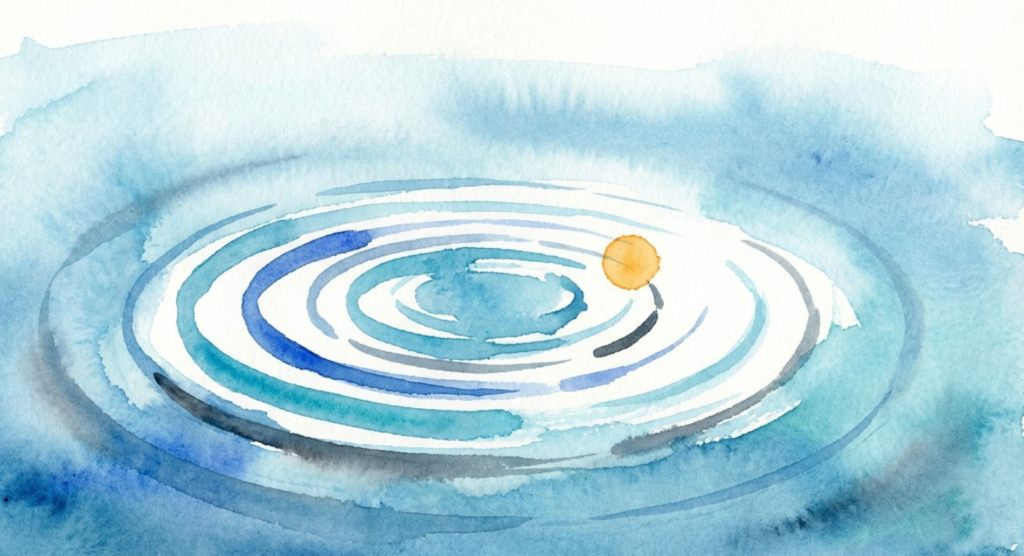
Art by Smita Srivastav, “Ripples“
About the Author
Makayla is passionate about politics, public policy, and understanding how decisions shape the nation. She writes to explore social issues, question systems of power, and make complex political ideas more accessible through clear and thoughtful storytelling.