

By Lucas Bohn
For decades, gravitational waves existed only as a theoretical prediction within Albert Einstein’s theory of general relativity. Today, they have become one of the most transformative tools in modern astrophysics. While observatories such as LIGO have successfully detected high-frequency gravitational waves generated by collisions between black holes and neutron stars, scientists are now beginning to observe an entirely different category of spacetime ripples: nanohertz gravitational waves.
Unlike the short, rapid waves detected by LIGO, nanohertz gravitational waves oscillate extremely slowly, with wavelengths so enormous that they may take years to pass through Earth. Because of their incredibly low frequency, traditional gravitational wave detectors cannot observe them directly. Instead, astrophysicists use pulsars, rapidly spinning neutron stars that emit highly regular radio pulses, as natural cosmic clocks.
By carefully monitoring tiny disruptions in the timing of these pulses across networks known as pulsar timing arrays, researchers have identified evidence of a faint gravitational wave background permeating the universe. In 2023, collaborations including NANOGrav, the European Pulsar Timing Array, and the Parkes Pulsar Timing Array announced findings consistent with the presence of nanohertz gravitational waves, marking one of the most significant developments in astrophysics in recent years.
Scientists believe these ultra-low-frequency waves may originate from supermassive black hole binaries, pairs of enormous black holes located at the centers of merging galaxies. As galaxies collide over billions of years, their central black holes gradually spiral toward one another, releasing vast amounts of gravitational energy into spacetime itself.
However, some astrophysicists speculate that nanohertz gravitational waves may also contain information from the early universe. Certain cosmological theories suggest these waves could preserve signatures from processes occurring shortly after the Big Bang, including cosmic inflation, phase transitions in the early universe, or even exotic cosmic strings predicted in theoretical physics.
The significance of this discovery extends beyond gravitational wave detection itself. Nanohertz gravitational waves open an entirely new observational scale in astrophysics, allowing scientists to study cosmic events unfolding over millions or billions of years rather than fractions of a second. Instead of observing isolated collisions, researchers may now begin studying the large-scale gravitational “background noise” of the evolving universe.
This development represents a major shift in how humanity studies the cosmos. Astronomy has historically relied on electromagnetic radiation, visible light, radio waves, infrared radiation, and X-rays. Gravitational wave astronomy, however, observes the universe through distortions in spacetime itself.
As pulsar timing arrays become increasingly precise, scientists may uncover deeper insight into galaxy evolution, supermassive black hole formation, and perhaps even conditions present near the beginning of the universe. The cosmos is no longer only something humanity observes through light; increasingly, it is something we are learning to hear.
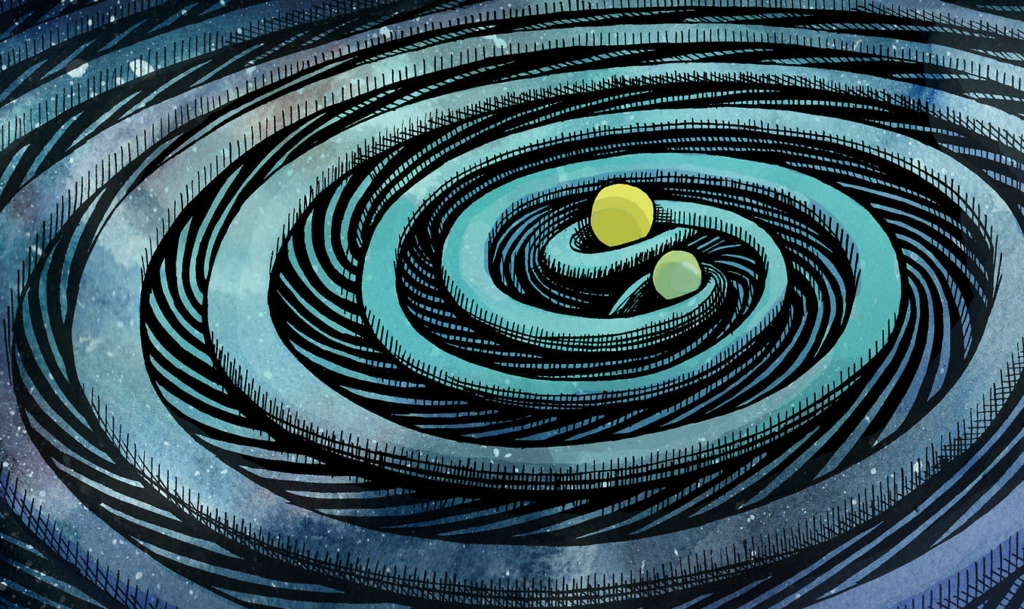
Art by Symmetry Magazine
About the Author
Lucas is an astrophysics enthusiast interested in cosmology, black holes, gravitational waves, and emerging developments in space science.