

Why One of Science’s Greatest Mysteries Still Remains Unsolved
by Lucas Bohn
For centuries, astronomy depended almost entirely on light. Scientists studied stars, planets, and galaxies by observing the radiation they emitted across space. However, modern astrophysics has revealed a troubling reality: most of the universe cannot actually be seen.
Current cosmological models estimate that ordinary matter, which spans the atoms composing stars, planets, oceans, and human life, accounts for only about five percent of the universe. The remaining majority is believed to exist as dark matter and dark energy, invisible components that continue to challenge modern physics.
Dark matter, despite never being directly observed, appears to shape the structure of the universe itself. Galaxies rotate at speeds that should theoretically tear them apart based on the visible matter they contain. Yet they remain intact. Astronomers believe an unseen form of matter provides the additional gravitational force necessary to hold these systems together.
Evidence for dark matter also appears on much larger cosmic scales. The vast “cosmic web” of galaxies stretching across the observable universe reflects patterns that visible matter alone cannot explain. Simulations of the early universe suggest that dark matter acted as an invisible gravitational framework around which galaxies eventually formed.
Despite decades of research, scientists still do not know what dark matter actually is. One major challenge is that dark matter does not appear to interact with electromagnetic radiation, meaning it neither emits nor reflects light. Researchers can only infer its presence through gravitational effects.
Several theories attempt to explain dark matter’s nature. One proposes the existence of Weakly Interacting Massive Particles (WIMPs), hypothetical particles that rarely interact with ordinary matter. Another theory explores axions, extremely light particles that may permeate the universe. More recently, some physicists have suggested that dark matter may not consist of particles at all, but instead reflect an incomplete understanding of gravity itself.
The search for answers has intensified through advancements in observational technology. The James Webb Space Telescope (JWST), gravitational wave observatories, and increasingly sophisticated computational models are allowing astrophysicists to examine the universe with unprecedented precision. Some researchers now believe gravitational waves generated during black hole mergers may contain subtle distortions caused by dark matter, potentially opening an entirely new method for studying it.
At the same time, new observations from JWST have identified massive galaxies and black holes forming unexpectedly early in cosmic history. These findings have challenged traditional cosmological models and renewed discussions about whether dark matter behaves differently than previously assumed.
The mystery surrounding dark matter represents more than a missing piece of astrophysics, it reflects the limits of current human understanding. For all of modern science’s advancements, the majority of the universe remains invisible and fundamentally unexplained.
Yet this uncertainty is also what makes astrophysics compelling. Each discovery raises new questions about the nature of space, gravity, and existence itself. As observational tools continue to evolve, scientists may eventually move closer to understanding the invisible structure shaping the cosmos.
References
- Rubin, V. C., Ford, W. K. “Rotation of the Andromeda Nebula.” Astrophysical Journal (1970).
- NASA. “What Is Dark Matter?”
- ESA/Webb Space Telescope mission updates on early galaxy formation.
- LIGO Scientific Collaboration, Gravitational Wave Detection Research.
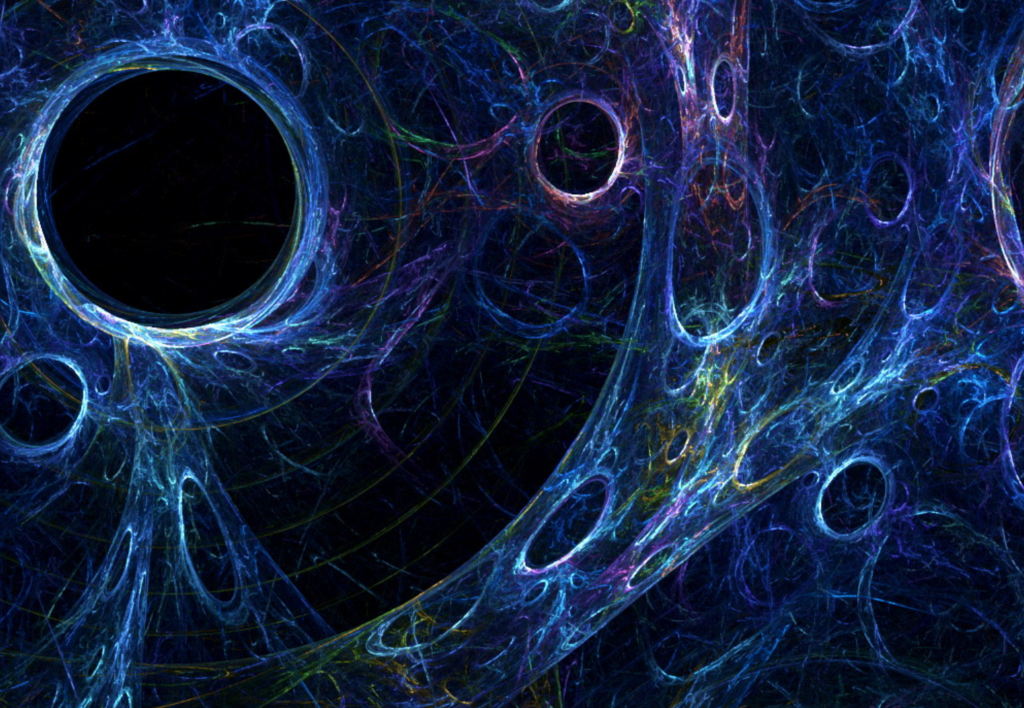
Art by Blurry Photos
About the Author
Lucas is an astrophysics enthusiast interested in cosmology, black holes, gravitational waves, and emerging developments in space science.