

by Lucas Bohn
The James Webb Space Telescope (JWST) and the growing field of gravitational wave astronomy are fundamentally changing humanity’s understanding of the cosmos. Astronomers are now approaching some of the oldest questions in science with unprecedented precision, largely due to rapid advancements in telescope technology, computational astrophysics, and gravitational wave detection. Questions that once remained entirely theoretical: what composes most of the universe, how cosmic structures emerged from primordial chaos, and what unseen phenomena may still exist beyond observable matter, are now becoming increasingly testable.
The most surprising development to come from the James Webb Space Telescope (JWST) is the detection of supermassive black holes existing in their host galaxies just a few hundred million years after the Big Bang, a result referred to as the cosmic dawn. These observations challenge many previous astrophysical models because black holes of such enormous mass should not have had enough time to form so early in cosmic history.
As a result, astrophysicists have been forced to reconsider long-standing assumptions regarding black hole formation and galaxy evolution. Some researchers now propose that supermassive black holes may grow far more rapidly than originally believed through periods of intense accretion, sometimes referred to as “feeding frenzies.” Others have explored more unconventional explanations involving dark matter. One emerging hypothesis suggests that decaying dark matter particles may accelerate the collapse of primordial gas clouds, allowing massive black hole ?seeds? to form significantly earlier than current cosmological models predict.
The James Webb Space Telescope (JWST) has located an intriguing type of object termed little red dots. They are very luminous and compact in the early universe. Scientists are not sure of what these objects are composed of. Some theorists think they could be fast-forming black holes hidden in dense gas/dust clouds. Other models propose these objects may be large primordial stars preparing to undergo gravitational collapse. Thus, scientific debate surrounding how early galaxies or black holes formed after the Big Bang is heightened by this discovery. Gravitational astronomy has also opened a new way of looking at the universe. Gravitational waves, first predicted by Albert Einstein’s general relativity, are tiny disturbances in space-time created by the collision of large mass objects (e.g. black holes, neutron stars) that cause space-time itself to strain.
In recent years researchers have started using gravitational waves as a tool for studying black hole mergers and exploring the unknown nature of dark matter. In May 2026 researchers from MIT suggested that dark matter could interact with gravitational wave signals by creating small distortions as two black holes revolve around each other. Researchers searched through historical merger data and identified a possible signal from one of the first detected “fingerprints” of dark matter interactions. Although these results are still preliminary, they have the potential to create a new type of method for studying the invisible substance thought to make up most of the universe.
Meanwhile, JWST has produced the most detailed map ever constructed of the cosmic web, the vast structure of galaxies and dark matter that forms the large-scale skeleton of the universe. The COSMOS-Web survey contains observational data from approximately 164,000 galaxies and offers new insight into how galaxies evolved over billions of years.
Together, these discoveries are reshaping astrophysics in real time. Concepts once considered speculative, including the behavior of dark matter, the origins of supermassive black holes, and the structure of the early universe, are now being investigated with remarkable accuracy. The universe, once silent to humanity, is becoming increasingly readable through light, gravity, and data.
As telescopes and gravitational wave observatories continue to advance, astrophysicists may come closer than ever to answering some of the oldest questions in science: What composes most of the universe? How did structure emerge from cosmic chaos? And how much of reality still remains hidden beyond what we can currently observe?
References
- “The growth of light seed black holes in the early Universe.” Nature Astronomy (2026).
- “An explanation for the massive black holes the JWST found in the early universe.” Phys.org (2026).
- “JWST spots two early black holes growing far faster than their galaxies.” Phys.org (2026).
- “Little red dots: the assembly of early supermassive black holes in the JWST Era.” Frontiers in Astronomy and Space Sciences (2026).
- “James Webb telescope reveals largest-ever map of the universe’s hidden megastructures.” Live Science (2026).
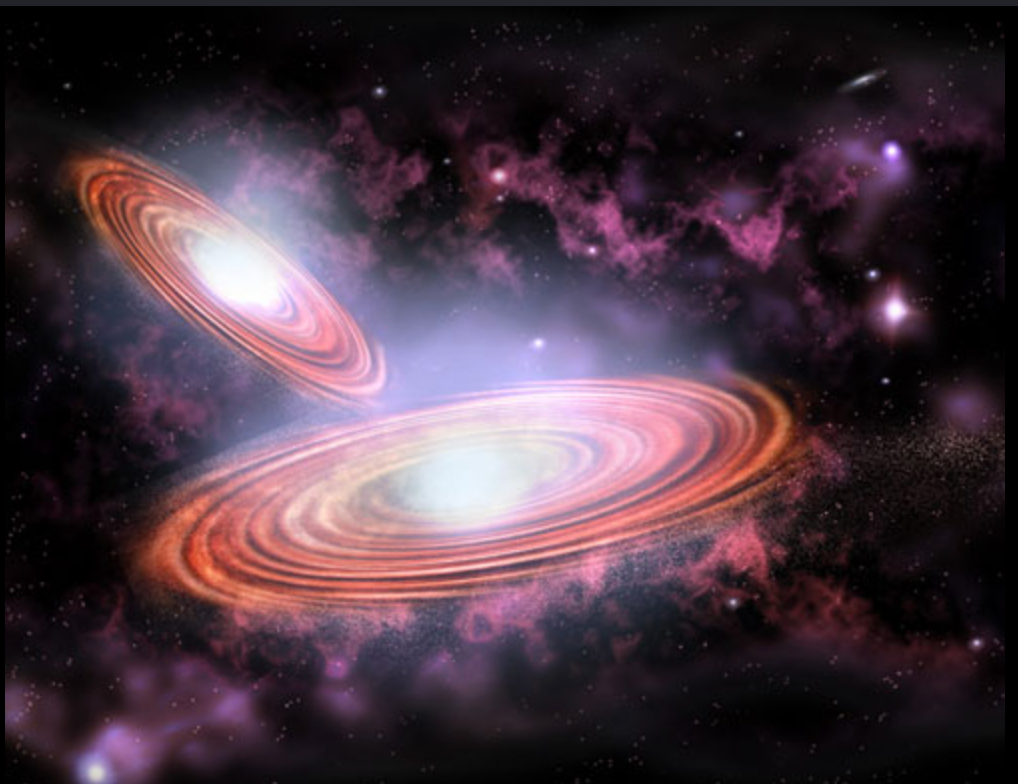
Art by Warped Space-Time Around Black Holes Visualized | Live Science
About the Author
Lucas is an astrophysics enthusiast interested in cosmology, black holes, gravitational waves, and emerging developments in space science.